.png)
How to Handle Peak Hour Phone Calls Without Breaking Service
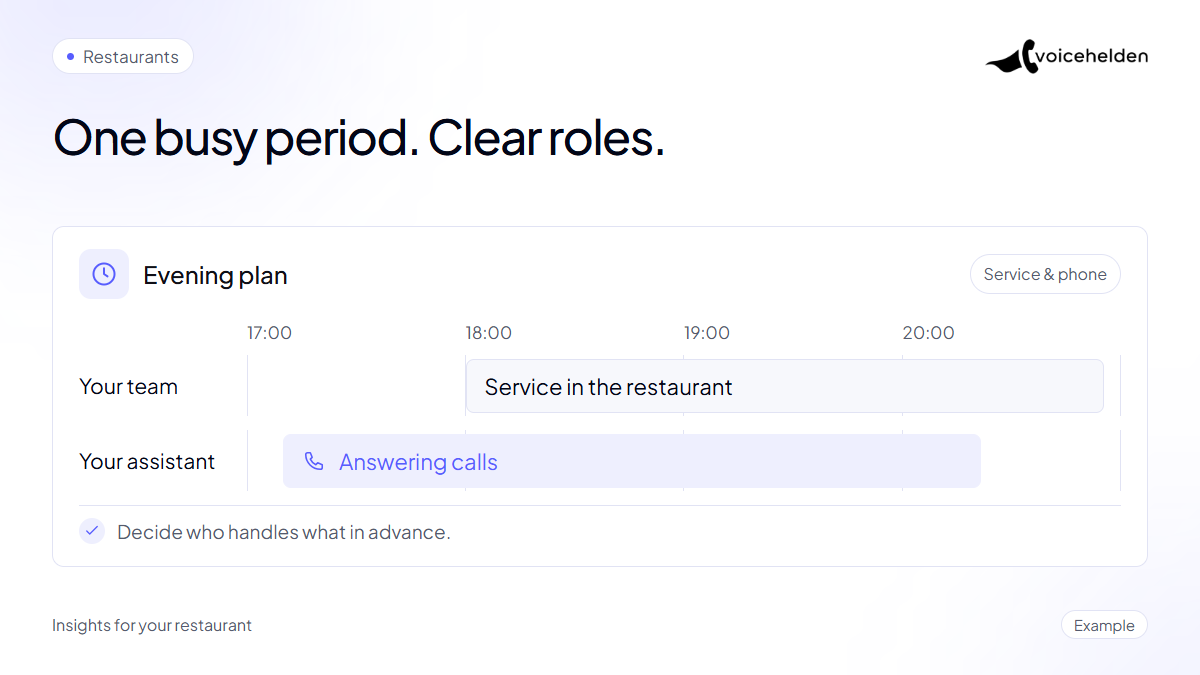
Peak call volume and peak service volume arrive at exactly the same time. Here is a practical framework for managing both, without asking your team to do the impossible.
When did you last count how many calls your restaurant missed during a single service? If the answer is never, you are not alone. Most operators manage their phone channel the way they manage noise on a busy night: they know it is a problem, they deal with each incident as it comes, and they never quite find the time to address the underlying cause.
The underlying cause is not a lack of effort. It is not undertrained staff. It is a timing problem so fundamental that no amount of motivation or scheduling fixes it: the hours when your restaurant receives the most calls are the exact same hours when your team is least able to answer them.
The overlap problem: when calls and service collide
Every restaurant has predictable peak windows, and you already know them. What most operators have not mapped explicitly is the direct overlap between high inbound call volume and high service demand. When you do, the scale of the conflict becomes clear. "PEAK" marks the periods where both call volume and service demand are highest at the same time, your points of maximum conflict.
| Service window | Mon | Tue | Wed | Thu | Fri | Sat/Sun |
|---|---|---|---|---|---|---|
| Lunch (12-2pm) | Low | Low | PEAK | PEAK | Low | Low |
| Evening (6-10pm) | Low | Rising | PEAK | PEAK | PEAK | PEAK |
| Sunday lunch (12-4pm) | Low | Low | Low | Low | Low | PEAK |
| Bank holidays | Rising | PEAK | PEAK | PEAK | PEAK | PEAK |
| Pre-opening (9-11am) | PEAK | Low | Low | Low | Rising | Rising |
Friday and Saturday evenings, Sunday lunch and bank holidays are where the conflict is most acute, and, not coincidentally, where the cost of a missed call is highest. These are the periods when customers are most motivated to book and least willing to wait.
Why the three most common fixes don't hold up under pressure
Designating a phone person. Assigning one staff member to prioritise the phone during service sounds logical. In practice, that person is still part of the floor team. When two tables need attention at once, which happens constantly, the phone becomes secondary. The designation is ignored because it has to be.
Asking staff to answer between tasks. This creates the worst possible phone experience: a hurried, distracted interaction where the caller senses they are an interruption. As we covered in our piece on the five ways restaurants lose customers over the phone, an answered call that goes badly can do as much damage as a missed one.
Relying on voicemail as a safety net. Data consistently shows that fewer than 15% of callers leave a voicemail when they reach one at a restaurant. The remaining 85% hang up, and most book elsewhere within minutes. Voicemail is not a safety net. It is a polite way of missing the call.
A five-approach framework for peak hour call management
The approaches below are ordered by implementation complexity, from lowest to highest. Most restaurants start at approach one and move forward as they understand the scale of the problem they are solving.
Pull your phone system's call log for the last four weeks. Identify the hours with the highest missed call rate, not the highest volume, but the highest proportion of calls that went unanswered. These are your high-risk windows.
Tip: most business phone systems, including basic mobile plans, have a missed calls log. Export at least 30 days before making changes.
For enquiries that don't need real-time availability, establish a dedicated booking window 30-60 minutes before service. Communicate it on your voicemail, Google listing and website. This shifts call volume out of peak hours.
Tip: update your Google Business Profile to reflect when calls are actively answered, not just when the restaurant is open.
A caller asking for directions can wait 30 seconds for a text back. A caller booking for six tonight cannot. Train your team to answer briefly, identify the call type in under 10 seconds, and either resolve it or offer a specific callback time.
Tip: create a laminated call-triage card for the pass: 3 call types, 3 responses. Keep it visible every service.
Group bookings, event enquiries and supplier calls should never compete with same-day reservation calls for the same line. Configure routing so non-urgent enquiries go to email or a callback option, freeing the primary line for live bookings.
Tip: check whether your phone provider supports time-based routing or IVR options, many do at no extra cost.
The four approaches above reduce the impact. This one eliminates it. AI answers every call during service hours, including peak evenings, without involving your team. Reservations confirmed, questions answered, group enquiries routed, sensitive calls escalated.
Tip: VoiceHelden can be configured in under an hour and goes live on the first call. No hardware, no technical setup, no new staff.
Pre-service peak hour checklist
Whether you are implementing approaches one through four or moving directly to five, this pre-service checklist reduces the damage during the transition period.
- Verify the phone is accessible: charged, visible, and audible over service noise.
- Confirm who is responsible for triage: one named person per service, stated at the pre-service briefing.
- Check voicemail is up to date: correct opening hours, booking routes and an estimated callback window.
- Review last service's missed calls: how many rang out, at what time. Adjust today's triage accordingly.
- Confirm AI routing is active (if live): dashboard running, routing rules correct for today's service.
- Brief the team on escalation: which calls get interrupted during service, complaints and large groups only. Everything else routes automatically.
What peak hour call handling looks like when it works
| Peak hours, current state | Peak hours, with VoiceHelden |
|---|---|
| Phone rings during full service, staff must choose | Phone answered automatically, team stays on floor |
| Call quality degrades under pressure | Every call handled identically, regardless of load |
| No visibility into call volume or missed calls | Full dashboard: calls in, resolved and escalated |
| Group bookings handled badly or missed | Group enquiries auto-routed to your events contact |
| Callers leave voicemail, 85%+ don't get a response | No voicemail. Every call resolved or escalated live |
| Staff stress spikes on Friday / Saturday | Team fully present on floor, zero phone interruption |
"The right system doesn't ask your team to do more during the hardest hours of their week. It removes the phone from their list of responsibilities entirely, and gives every caller the same quality of attention your best table gets."
Peak hour call management is not a staffing problem and not a training problem. It is a systems problem, and systems problems have systems solutions. Start by pulling your missed call data, here is how, it will tell you exactly which approach you need, and how urgently.
VoiceHelden answers every call during peak service.
Off-peak, overnight and at weekends, automatically and professionally, so your team never has to choose again.
Built and live within 15 minutes. Free to build and test. 7 days free, then from €79 a month, excl. VAT. Card up front, cancel any time. Or pay now with 20% off, from €63.20 a month, excl. VAT, with a 30-day money-back guarantee.