.png)
How Many Calls Does Your Restaurant Actually Miss Every Week?
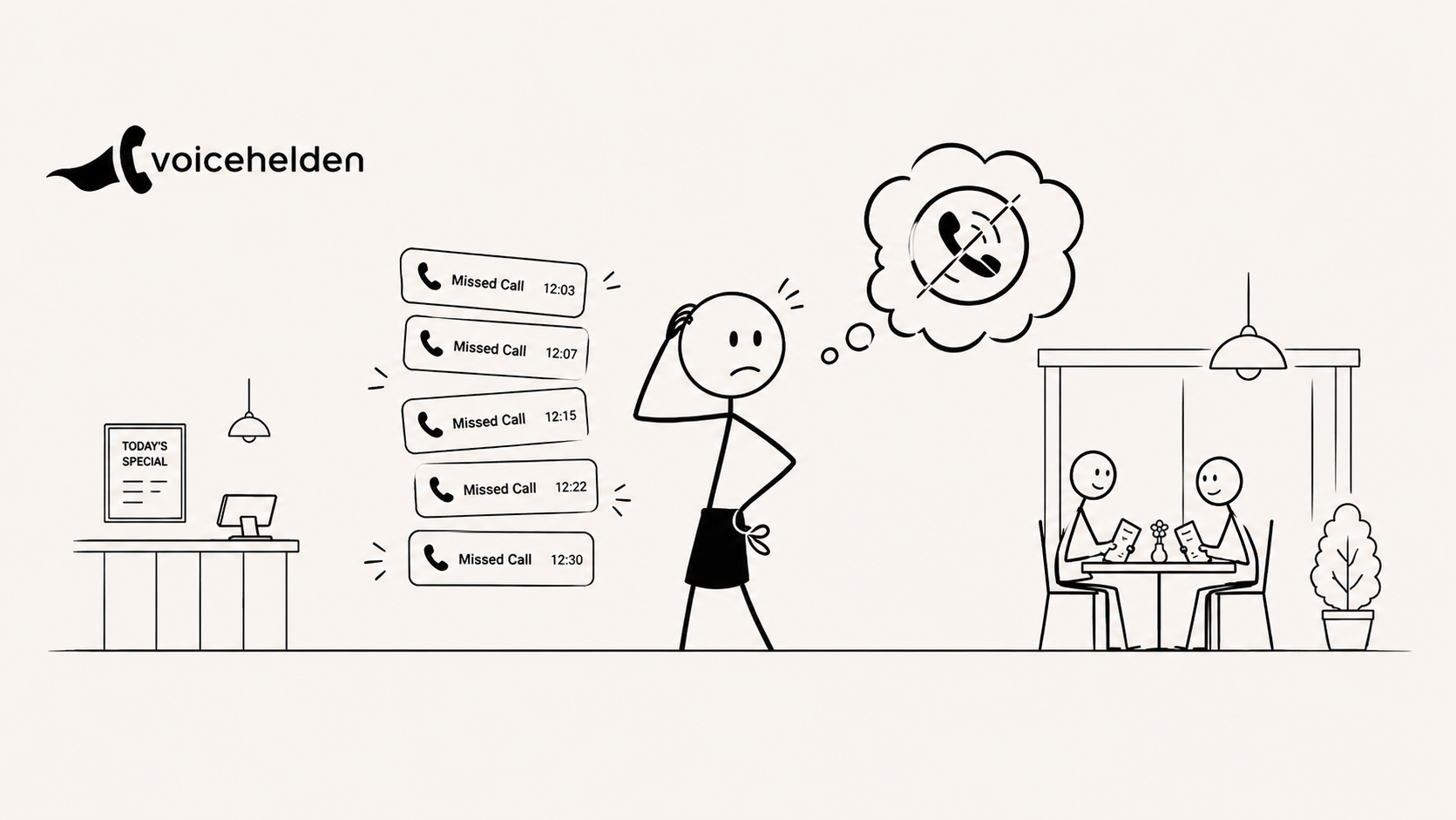
Most restaurant owners know they're missing calls. Almost none of them know exactly how many — or what those calls are costing every week. Here's how to find your number, what it means for your revenue, and what you can do about it.
The average busy restaurant misses between 20 and 40 incoming calls every week. At an average booking value of £45 — or $55 in the US — that's somewhere between £900 and £1,800 leaving your business every single week. Before you've opened the kitchen. Before a single table has been turned.
Most owners know, instinctively, that calls are going unanswered. Very few have ever worked out what those missed calls actually cost. This article gives you the framework to do exactly that — and shows you why solving it is one of the highest-return operational decisions you can make.
Why restaurants miss so many calls — and don't realise it
Here's the thing about missed calls: they don't announce themselves. A call that goes unanswered doesn't leave a gap in your reservation book. It doesn't show up as a complaint. The customer on the other end simply puts their phone down and books somewhere else. Your restaurant never knew they were there.
The calls go unanswered for entirely predictable reasons. Your team is mid-service and the phone is three metres away behind the bar. A table of eight just walked in without a reservation. It's 7:45pm on a Saturday and every member of staff is doing three things at once. The phone competes with the dining room, and the dining room always wins. The result is that between 15% and 30% of calls during service hours go unanswered.
How many calls is your restaurant actually missing?
The honest answer is: without tracking, you don't know. But you can make a strong estimate using a simple framework any restaurant manager can run immediately. Start with your peak service periods — Friday and Saturday evenings, Sunday lunch, and any bank holiday. During these windows, 25–40% of all incoming calls go unanswered.
If you take around 120 calls a week and 25% go unanswered during peak hours, that's 30 missed calls. At a 70% conversion rate, that's 21 lost reservations per week. At £45 per head for a table of two, one missed call costs £90. Twenty-one missed calls per week costs £1,890 — nearly £100,000 per year, from calls that rang out.
× missed call rate (25–40%)
× booking conversion (70%)
× average booking value
= weekly revenue lost to unanswered calls
The true cost goes beyond the booking
The direct revenue figure is only part of the picture. Every missed call carries a second cost that doesn't show up in any spreadsheet: the customer who doesn't come back. Research consistently shows that when a restaurant doesn't answer, the majority of callers do not try again. They book a competitor.
For restaurants in competitive city markets — London, Manchester, New York, Amsterdam, Paris, Berlin — this is particularly acute. The caller isn't loyal to one restaurant. They're loyal to whoever answers first. An unanswered call in a busy market is, in most cases, a customer handed directly to a competitor.
Why the usual solutions don't solve the problem
Voicemail. Fewer than 15% of callers who reach a restaurant voicemail leave a message — in the US, below 9%. The overwhelming majority hang up immediately. Voicemail does not capture the missed booking.
Hiring a dedicated receptionist. For a small or independent restaurant, this is economically unworkable. A full-time receptionist costs £25,000–£32,000 per year in the UK, or $35,000–$45,000 in the US. A part-time receptionist still doesn't cover peak evening hours. And no human receptionist works 24/7.
Telling staff to prioritise the phone. This works until service starts. During peak hours, a member of floor staff answering a 3-minute call costs the table their experience and presence. The dining room will always — and rightly — take priority.
What solving this problem actually looks like
The restaurants that have solved the missed call problem have done it the same way: by removing the dependency on a human being available to answer the phone at the exact moment a customer calls.
AI call handling ensures every call that comes in is answered — immediately, professionally, and with the right response — regardless of whether your team is mid-service or it's 11pm on a Tuesday. The caller doesn't get voicemail or a ring-out: they get a professional response that can take a reservation, answer common questions, and escalate to a member of staff where needed. This is not a system that replaces your team. It protects your revenue during the hours when your team simply cannot be in two places at once.
"We were missing an estimated 25–30 calls a week during Friday and Saturday evenings. Within six weeks of using VoiceHelden, we had zero missed calls and our online booking confirmation rate had increased by 34%."
— General Manager, Independent restaurant group, UK (3 sites)
How to find your missed call number — starting this week
- 01
Check your phone system's call log
Most modern phone systems — including basic business mobile lines — show missed call data. Pull this for the last four weeks and identify the pattern: how many per day, at what hours, on which days.
- 02
Identify your peak miss windows
These are almost always Friday and Saturday evening (6pm–9pm), Sunday lunch (12pm–3pm), and the 30 minutes before opening. These are the hours where call answering is structurally impossible during service.
- 03
Apply the revenue formula
Missed calls × 70% (likely bookings) × average booking value. Calculate weekly, then annually. The annual number is the one that matters — it's what this problem is genuinely costing your restaurant.
- 04
Decide what an acceptable miss rate is
For most restaurants, zero is the target. Not because perfection is required — but because any missed call above zero is revenue your restaurant earned the right to receive, and then didn't.
- 05
Build a solution around the gap
Once you know when you're missing calls and how much it costs, the business case for AI call handling becomes straightforward arithmetic — not a technology debate.
The missed call problem is not a staffing problem. It is not a technology problem. It is a structural problem — one that exists in every restaurant that tries to answer a phone during service hours with the same team that is running the dining room.
The good news is that it is entirely solvable. The restaurants solving it today are not doing anything complicated. They are simply ensuring that every call their marketing budget, their reputation, and their food quality worked to generate — actually gets answered.
VoiceHelden answers every call, 24/7.
Your team stays focused on service. Not a single booking falls through the gap.
Built and live within 15 minutes. Free to build and test. 7 days free, then from €79 a month, excl. VAT. Card up front, cancel any time. Or pay now with 20% off, from €63.20 a month, excl. VAT, with a 30-day money-back guarantee.