.png)
5 Reasons Your Restaurant Keeps Losing Customers Over the Phone
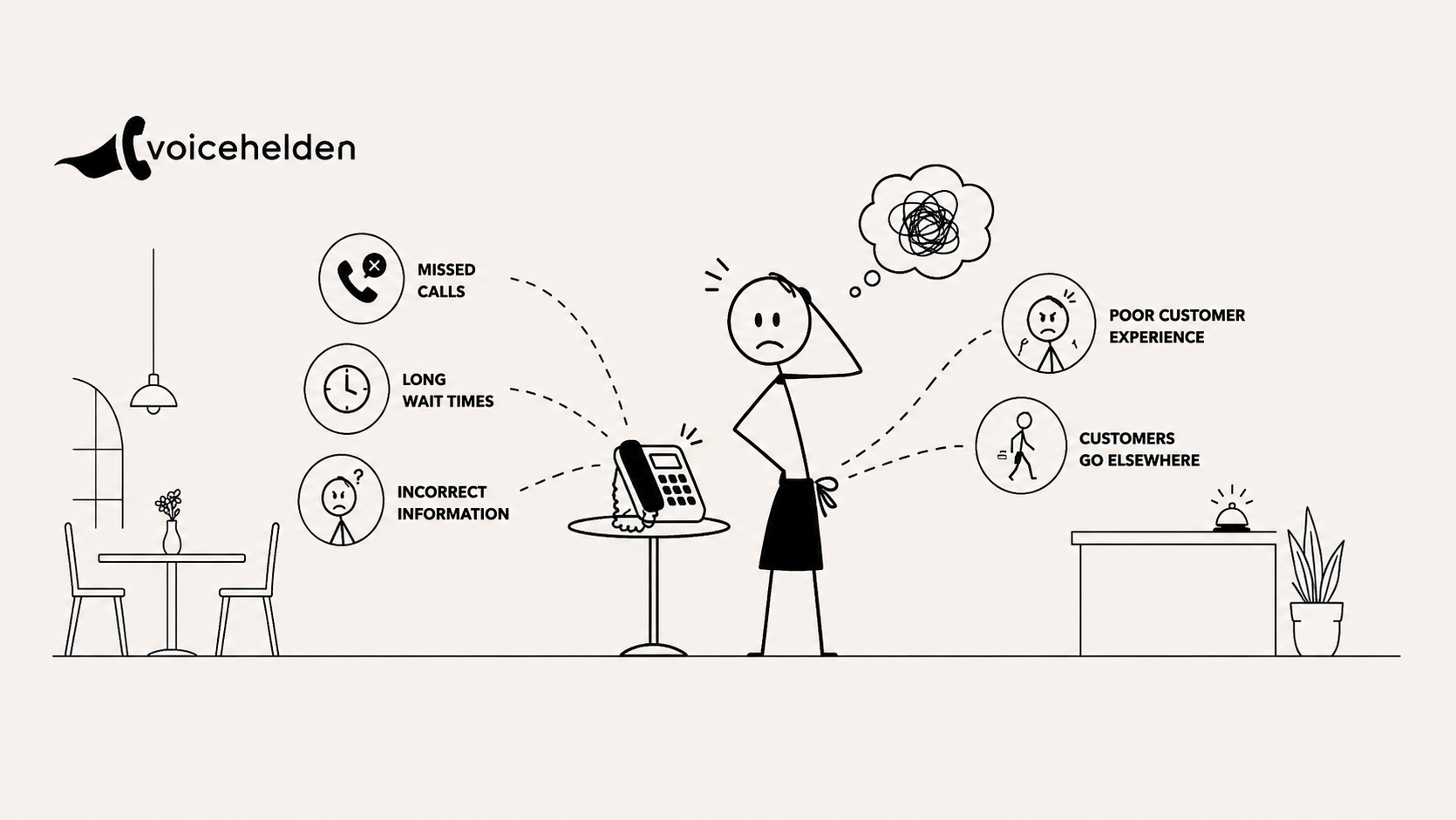
Your restaurant's phone is doing more damage to your customer relationships than you realise — and it's happening before a single guest walks through the door. Here are the five ways it's costing you, and what to do about each one.
Think about the last time you called a restaurant and nobody answered. What did you do? Did you call back? Or did you spend thirty seconds searching for somewhere else and book there instead? If you're honest, it was probably the last one.
Your customers are doing exactly the same thing, every week, when your phone goes unanswered. The problem is rarely a single catastrophic failure. It is five smaller, structural problems — each quietly eroding your customer relationships and your bookings.
The five reasons — and why each matters more than it looks
Most operators assume missed calls are the only problem. They're not. The phone creates five distinct failure points, and each damages your relationship with customers in a different way. Some are obvious. A few are invisible until you look for them.
- 01
Your phone rings out during service — and customers hear silence
A caller who intends to book, who found you online, who is ready to confirm — hears a ring, then another, then nothing. The restaurant that caused this experience is yours. But the booking goes elsewhere. Across markets, 78% of callers who don't reach a restaurant on the first attempt do not try again.
Customer impact: The caller's perception shifts from "great place, excited to visit" to "can't reach them, can't rely on them." First impressions in hospitality happen before the meal. This is yours. - 02
Your voicemail is doing the work — but almost nobody uses it
Most restaurants rely on voicemail as a backup. But fewer than 15% of callers who reach a restaurant voicemail leave a message — below 9% in the US. A voicemail in hospitality feels like a closed door, not an invitation. The new customers you most need to capture walk straight past.
Customer impact: Voicemail creates the illusion of coverage. The customer experiences rejection. The booking never happens. - 03
Calls are answered — but by someone mid-service, distracted and rushed
This failure point almost never gets discussed: not the missed call, but the answered call that goes badly. A floor team member who picks up during a busy service is doing two jobs at once. The result feels hurried and impersonal. Reservation details are taken incorrectly.
Customer impact: The booking may be taken — but the customer has already formed an impression. It is not the one your restaurant would choose. - 04
Your phone experience doesn't match your restaurant's brand
You spend time, money, and creative energy on your identity — the menu, the décor, the way your team greets a guest. Then a guest calls and the phone is answered with "Yeah, hold on" while someone covers the receiver. The brand dissonance is jarring, and it matters disproportionately to new customers.
Customer impact: The customer's mental model of your restaurant is set before they arrive. A mismatched phone experience undermines everything else you've built. - 05
You have no visibility into what's happening on your phone
The fifth reason makes the other four so hard to fix: most restaurants have no data on their phone performance. How many calls came in? How many were answered? Without answers, the phone is a black box — problems that could be solved in days go undetected for months.
Customer impact: You cannot improve what you cannot see. The phone problem persists because it hides.
What connects all five — and how AI solves each at the source
These five problems share a common root cause: the phone channel in most restaurants is unmanaged. It is not staffed, monitored, or designed as a customer touchpoint. It simply exists.
An AI system built for hospitality, like VoiceHelden, addresses all five at the source rather than patching each one individually.
✓Every call answered
Ring-outs eliminated entirely. Every caller receives an immediate, professional response — during service, at peak hours, overnight, at weekends.
✓Voicemail replaced
Callers are not routed to voicemail. They are handled — their enquiry addressed, their reservation confirmed.
✓Staff freed from the phone
Your team stays present on the floor. Call handling happens in the background. The distracted, mid-service phone answer is eliminated.
✓Consistent brand voice
Every call is handled the way you configure it — warm, professional, and on-brand. Every time. Without variation.
The pattern worth noticing
None of these five reasons requires a bad team or a badly run restaurant. All five happen in restaurants that are genuinely excellent at hospitality — the moment that hospitality relies on the phone.
As we covered in our deep-dive on the real cost of missed calls, the financial consequence runs to tens of thousands per year. But the customer relationship damage — the impression formed during a rushed answer, the booking lost to a competitor — is harder to quantify and harder to reverse.
Your front-of-house team creates an experience many guests describe as the best part of their evening. The phone doesn't have to undermine that before it even begins.
Solving these five problems is not complicated. It doesn't require hiring, training, or restructuring. It requires treating the phone channel — the first touchpoint for a significant share of your customers — with the same deliberate care you give to everything else.
VoiceHelden answers every call — 24/7.
No ring-outs. No voicemail. No missed bookings.
Built and live within 15 minutes. Free to build and test. 7 days free, then from €79 a month, excl. VAT. Card up front, cancel any time. Or pay now with 20% off, from €63.20 a month, excl. VAT, with a 30-day money-back guarantee.