.png)
You Build the Logic. Let AI Handle the Routing.
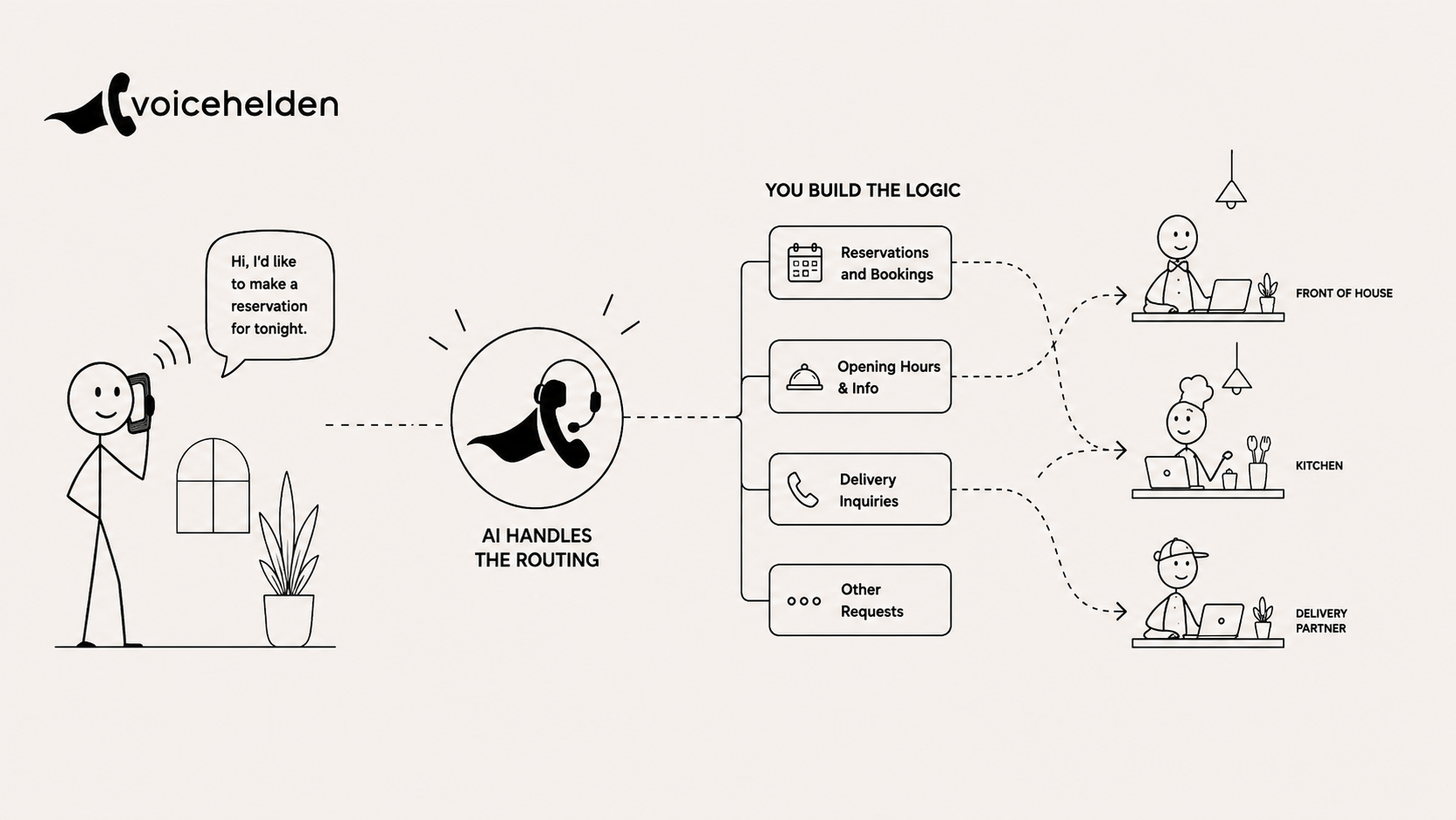
Most AI answering systems answer your phone. VoiceHelden executes your thinking. Here is the difference — and why it matters for every call your restaurant receives.
There is a version of AI call handling that simply picks up the phone, plays a message, and asks the caller to press one for reservations. You have experienced it. It felt like being processed. Not served.
What has changed — fundamentally, not incrementally — is the move from systems that follow a script to systems that execute logic. VoiceHelden was built on one premise: the people who understand how your restaurant's phone should work are you and your team, not the software developers. You define the logic. The AI executes it.
You build the logic. Let AI handle the routing.
The difference between answering and thinking
Most AI phone systems intercept the call, play a pre-recorded response, and push a notification. The AI is passive — it waits for the caller to do the work.
Intelligent routing is different. It starts not with the phone, but with a question: what should happen when this type of caller, with this need, calls at this time of day? The intelligence is not in the AI's ability to improvise — it is in its ability to faithfully execute the decisions you have already made.
Script vs. intelligent routing
| Script-based AI answering | VoiceHelden intelligent routing |
|---|---|
| Plays a fixed message on every call | Detects caller intent and responds contextually |
| Caller navigates a menu: press 1, press 2 | Natural conversation — no menus, no numbers |
| No differentiation by call type or time | Different logic for different call types and hours |
| Information captured but logic is static | Your routing rules run on every call, every time |
| Updates require contacting your provider | You update your own logic instantly, in the dashboard |
| Callers feel processed, not served | Callers receive a professional, brand-consistent experience |
You already know how your calls should be handled
The routing logic for your restaurant already exists — it lives in the heads of your management team. Your head of front-of-house already knows that group enquiries over ten people go to the events manager. Your floor manager knows a complaint should never be resolved over the phone without a manager.
This institutional knowledge is exactly what VoiceHelden lets you encode. You're not programming a system from scratch — you are documenting decisions you have already made, and giving the AI the authority to execute them consistently.
"The setup was not as complex as I expected. We spent about an hour mapping out how we wanted different call types handled. Once it was running, it handled everything exactly as we would have — except it did it on every call, at every hour."
— Operations Manager, independent restaurant group, Netherlands
What routing logic looks like in practice
To make this concrete: here is how a typical restaurant's call routing logic works inside VoiceHelden. Each row represents a caller scenario, what the AI does, and when — if ever — it escalates to a human.
Routing logic — 7 scenarios
| Caller trigger | What VoiceHelden does | Escalation rule |
|---|---|---|
| "I'd like to make a reservation" | Confirms date, time, party size — logs booking | Never — fully automated |
| "Do you have any tables tonight?" | Checks availability and responds with options | Only if availability unclear |
| "I need to cancel my booking" | Confirms cancellation, updates the system | If pre-paid or large group |
| "I have a complaint" | Acknowledges, collects details, offers callback | Always — flagged as priority |
| "What time do you close?" | Answers from your configured info | Never — fully automated |
| "I'd like to book for 14 people" | Identifies group enquiry, captures details | Routed to events team |
| Caller does not respond / silent | Waits, prompts twice, then logs as missed attempt | Flagged for follow-up |
The five-step call journey — from ring to resolution
- 01
Incoming call
Call arrives at your restaurant number — any time, any day.
- 02
Intent detected
AI identifies caller intent: booking, query, cancellation, or other.
- 03
Your logic runs
VoiceHelden applies the routing rules you configured.
- 04
Action taken
Reservation confirmed, question answered, or call escalated to staff.
- 05
Outcome logged
Full interaction recorded in your dashboard for review and improvement.
The compounding benefit: every call makes the next one better
There is a second-order benefit most operators don't anticipate: the data. Every call is logged, categorised, and made available in your dashboard — a complete picture of what your callers want and when they call.
A restaurant running VoiceHelden for 90 days knows its peak call windows to the minute, knows the three questions that account for 40% of inbound volume, and has adjusted its routing logic accordingly.
What this means for your team — and your guests
The most immediate effect is one your team feels before your guests do: the phone stops being their problem. For a busy team, the phone is a persistent source of low-level stress — it rings at the wrong moment and forces a split-second decision: answer it, or stay with the table?
When calls are handled intelligently in the background, that decision disappears. Your team is present. And the missed booking costs that accumulate invisibly — week after week — no longer pile up.
The shift from script to logic is not a technical upgrade. It is a philosophical one. It is the difference between a phone system that makes callers work for their booking and one that works as hard as your team does — with the same standards and priorities.
You already know how your calls should be handled. VoiceHelden gives that knowledge somewhere to live — and the means to act on it, on every call you receive.
Build your call logic once. Let VoiceHelden execute it on every call.
No scripting. No setup complexity. See it in action in 15 minutes.
Built and live within 15 minutes. Free to build and test. 7 days free, then from €79 a month, excl. VAT. Card up front, cancel any time. Or pay now with 20% off, from €63.20 a month, excl. VAT, with a 30-day money-back guarantee.