.png)
The Real Cost of a Missed Restaurant Booking Call (With Numbers)
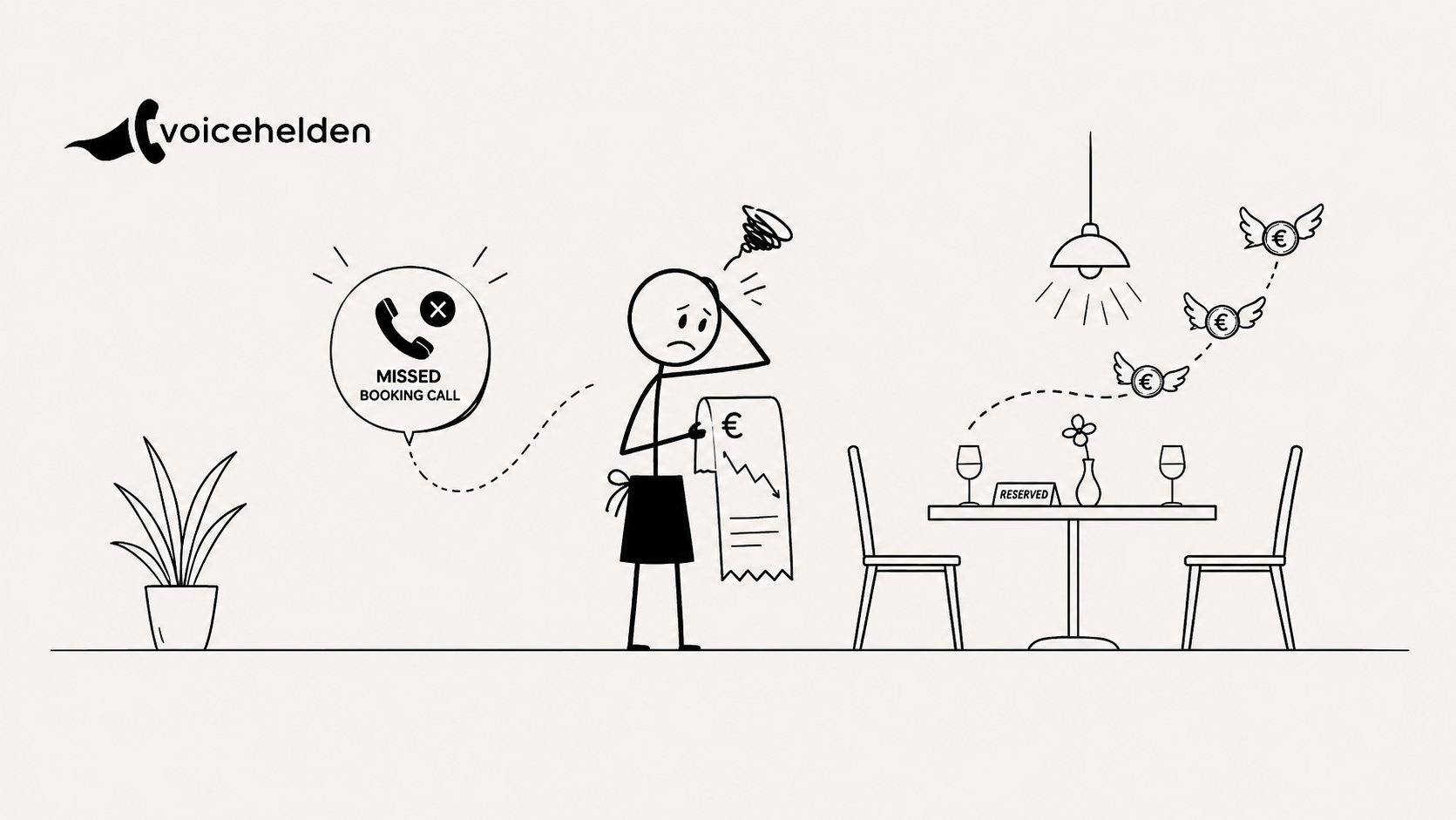
One missed call to your restaurant is not just a missed call. It is a number — a specific, calculable figure that shows up in your annual revenue whether you track it or not. This is what that number actually looks like.
Nobody in hospitality would accept losing £50,000 from their annual revenue without investigating why. But every year, that is exactly what thousands of restaurants across the UK, US, and Europe are doing — through a cause that never appears on a P&L, never generates a complaint, and never triggers an audit. A phone that rings out.
The cost of a missed restaurant call is not abstract. It is arithmetic. This article breaks down what each unanswered call actually costs — by direct booking value, by customer lifetime value, by competitive displacement, and by reputational impact.
Start with the direct number: what one missed call costs
The simplest version of the calculation is: average booking value × booking conversion rate. If your average table spends £90, and 70% of callers who get through go on to book, one missed call costs your restaurant £63 in direct lost revenue.
That figure shifts by market and restaurant type. Here are the baseline numbers, based on average spend per cover and typical table sizes.
= average booking value
× booking conversion rate
e.g. £90 × 70% = £63 per missed call
Cost per missed call, by restaurant type
| Restaurant type | Spend/cover | Table size | Conversion | Cost/missed call |
|---|---|---|---|---|
| Café / wine bar | £22 / $27 / €24 | 1.8 | 65% | £26 / $32 / €28 |
| Independent restaurant | £42 / $52 / €46 | 2.4 | 70% | £71 / $87 / €77 |
| City-centre restaurant | £58 / $72 / €63 | 2.6 | 72% | £108 / $134 / €118 |
| Fine dining / destination | £95 / $118 / €105 | 2.8 | 78% | £207 / $257 / €229 |
| Group bookings / events | £380 / $470 / €420 | 8.0 | 80% | £304 / $376 / €336 |
The annual number: what your finance team would say
Annualising the weekly loss is where the number becomes genuinely difficult to ignore. The average busy restaurant misses 20 to 40 calls per week; at 30 missed calls per week for a mid-size city restaurant, the direct weekly revenue lost is over £3,200.
For a restaurant group with three or more sites, the annual figure sits comfortably above £250,000. That is not a rounding error. That is a revenue line that should be on every quarterly review.
Annual cost of missed calls — by restaurant type
| Restaurant type | UK (£) | US ($) | Europe (€) |
|---|---|---|---|
| Small café / wine bar (40 calls/wk) | £28,000–£42,000 | $34,000–$52,000 | €26,000–€40,000 |
| Independent, 40–60 covers (80/wk) | £56,000–£84,000 | $68,000–$103,000 | €52,000–€78,000 |
| Busy city-centre restaurant (120+/wk) | £84,000–£126,000 | $103,000–$155,000 | €78,000–€117,000 |
| Restaurant group, 3–5 sites | £252,000–£378,000 | $308,000–$465,000 | €234,000–€351,000 |
The hidden multiplier: customer lifetime value
The direct booking value is only the first layer. Sitting behind it is a larger number most owners never calculate: customer lifetime value. A customer who returns six times per year is not worth £90 to your business — they are worth £540 per year, and potentially £2,700 over five years, before referrals and group bookings.
When a call goes unanswered and that customer books a competitor instead, you are not losing one booking. You are losing all the future visits they would have made — at the precise moment your restaurant had their attention and their intent.
Average spend per visit: £85
Typical loyalty duration: 3–6 years
Conservative lifetime value: £1,275 per customer
Competitive displacement: the cost your competitor doesn't mention
In a competitive dining market, the customer who cannot reach your restaurant does not stop wanting to eat out. They open a browser, scroll Instagram, or simply call the restaurant they passed last week. Your missed call is your competitor's answered call.
Research consistently shows that fewer than 22% of callers who fail to get through try the same restaurant again that day. The other 78% go elsewhere — and many stay elsewhere. Within a 500-metre radius of most urban restaurants there are between three and twelve direct competitors, every one a click or a call away.
The review effect: how missed calls reach your Google rating
"Called twice, nobody answered." This is a recurring theme in one-star restaurant reviews across every market. The meal hasn't happened. The food hasn't been tasted. But the review is already written, and visible to every future customer who searches for your restaurant.
Review scores directly influence booking rates. A restaurant at 4.6 stars generates measurably more bookings than one at 4.2. The phone experience is often the first impression a new customer has — and an unanswered call does not produce a neutral response. It produces frustration, and frustrated customers write reviews.
"I tried to book for my wife's birthday. Called three times over two days, nobody answered. Ended up going to [competitor]. Really disappointed — I'd heard great things."
— 2-star Google review, independent restaurant, South London
What solving it costs — and why the maths is straightforward
The cost of not solving the missed call problem is, as the numbers show, measured in tens of thousands of pounds per year for most restaurants. The cost of solving it with AI call handling is a fraction of that.
The comparison makes the decision simple arithmetic. An independent restaurant losing £85,000 per year in missed call revenue does not have a complicated cost-benefit analysis to run. The question is not whether to solve the problem. The question is how quickly.
The options compared
| Solution | Annual cost | Calls covered | ROI realism |
|---|---|---|---|
| Voicemail only | £0 / $0 | Handles <15% of missed calls | Negative |
| Part-time receptionist | £12,000–£18,000 | Peak hours only | Marginal |
| Full-time receptionist | £28,000–£35,000 | Office hours only | Partial |
| AI call handling (VoiceHelden) | Fraction of the above | 100% — 24/7, every call | High |
A missed call is not an inconvenience. It is a transaction that almost happened — one your restaurant earned the right to receive through its marketing, its reputation, and its product — and then didn't. Every week a restaurant operates without a solution, it is choosing to leave a specific and calculable amount of money on the table.
The number is different for every restaurant. But it is never zero. And it is almost always larger than owners expect when they calculate it for the first time.
VoiceHelden answers every call — so none of that revenue walks out the door.
See it working in 15 minutes. Your team stays focused on service.
Built and live within 15 minutes. Free to build and test. 7 days free, then from €79 a month, excl. VAT. Card up front, cancel any time. Or pay now with 20% off, from €63.20 a month, excl. VAT, with a 30-day money-back guarantee.